We will install, maintain, repair and design the right gas or chemical fire suppression system to suit your needs. We will provide you with the right fire safety equipment, including fire extinguishers to aid in fire suppression.
The nature of your business, or the type of fire your building or operation is at risk for, will determine the best type of fire suppression system for you. We can help you assess the many systems currently on the market and come up with a fire suppression design that will meet your needs and fit your budget.
Jump to a section on this page:
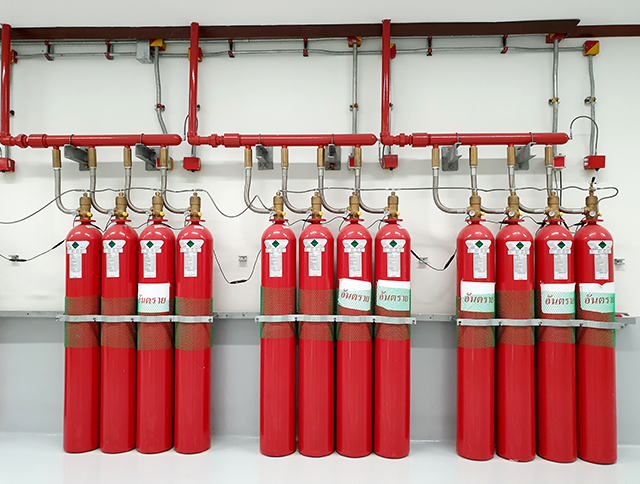
Chemical and gas fire suppression systems are used in operations where water is either an inappropriate extinguishing agent or where water could cause irreparable damage to a building’s contents.
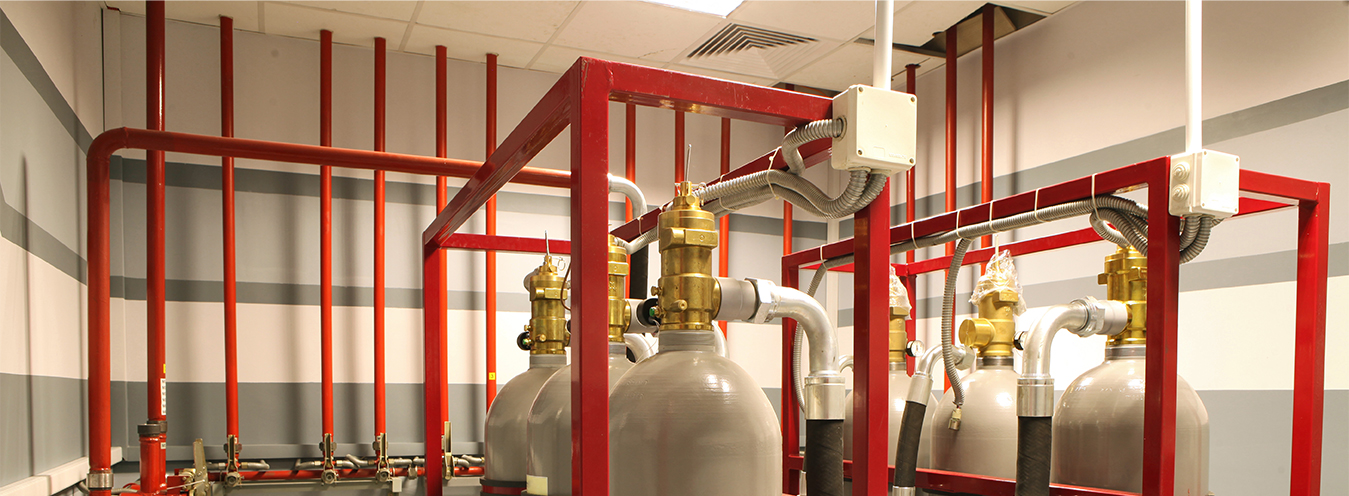
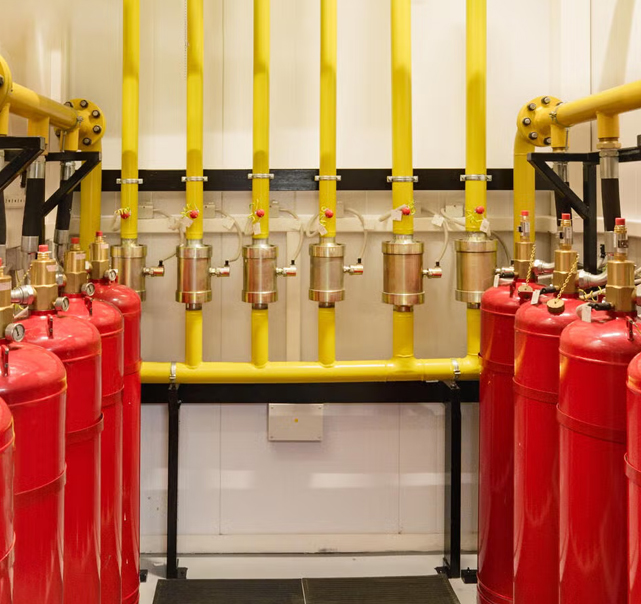
Fire suppression systems operate similarly to fire sprinklers. The fire suppressant is stored in pressurized containers, usually in a dedicated room or central station. From there, the cylinders are connected to an overhead pipe grid. Upon activation of the fire alarm panel or a manual pull station, the suppressant floods the pipes and is then dispersed through affixed nozzles.
Suppression systems are either total flood or local. Total flood means that is they are piped into a room that has been sealed. Local means they are dispersed through specified nozzles in unsealed rooms. Our suppression systems are made up of many parts, and we use only the best installation methods and manufacturers to ensure your system stays in tact for many years to come.
We provide fire extinguisher and suppression system installation. When we service such systems, each piece of equipment goes through a thorough inspection to ensure quality and safety. Our fire suppression systems go through a carefully calculated design process. We ensure placement is optimal and will provide you with the fire protection you need. This is needed to maintain life safety.
We use a variety of quality fire extinguishers from trusted manufacturers. Popular manufacturers we have access to include Novec, Ansul (Tyco, Inergen), Protex, Range Guard, Kidde and Afex. Each manufacturer makes a range of different types of fire extinguishers. The systems we most often install and maintain include:
We will go into some detail about a the most popular pieces of fire extinguishing equipment and suppression systems around.
For a long time Halon 1301 was classified as the superior method of fire suppression in the extinguishment for all classes of fire without causing damage to the equipment being protected.
Due to severe environmental contamination issues & depletion of the ozone layer a new method of protection of valuable assets was developed: FE 200.
FE 200 systems are engineered to achieve extinguishment of a fire within 10 seconds or less. Contact us for more info for both service and installation.
Prior to 1994, the Halon line of fire extinguishers was the industry-standard for complete fire suppression. However, due to its ozone-depleting properties, its manufacture was phased out in 1994. This created a need for suppressants of similar quality that could be used in operations where humans would be present. Today, the most prevalent halon replacements include FE 200, Novec 1231 and Halotron.
These products are usually stored as pressurized liquids and dispersed as vapors or gasses. They work by interrupting the fire’s chemical reaction. They act extremely quickly, with FE 200 having the ability to extinguish a fire within 10 seconds. These products have low toxicity, excellent environmental profiles and do not leave behind any debris or particulate. They’re extremely safe for occupants. We recommend them for number of applications that are vulnerable to Class A, B or C fires including:
Inert gases extinguish fires by reducing the level of oxygen in a room to below 15% by volume. At that level, a fire cannot sustain itself. Inert gas fire suppression is usually a combination of nitrogen and argon, and sometimes carbon dioxide. Ratios of the gases vary depending on the manufacturer’s proprietary blend. Popular types are Argonite, IG-55, Inergen.
Inert gas fire suppression is considered a clean agent, with little or no adverse effect on the environment. It leaves behind no particulate or debris, and is not electrically conductive. It is safe for humans while they evacuate, although prolonged exposure to a lack of oxygen is lethal. Operations that we recommend inert gas for include:
Carbon dioxide fire suppression is inexpensive, does not harm the environment and does not leave behind debris or particulate. However, we don’t recommend it in occupied areas as it significantly reduces the amount of oxygen humans need to breathe. For total flood applications, it is only recommended for unoccupied areas such as spray-paint booths and mechanical rooms.
Carbon Dioxide is also an excellent choice for marine applications. Boats and other marine vessels present a number of fire hazards including flammable liquids, fuel lines, oils and solvents all within a contained environment that must be fire-suppressant self-sufficient.
Chemical fire suppression systems work by smothering the fire. Chemical formulations can be a dry chemical, or wet and dispersed as foam. Dry chemical fire suppression is used in Class A, B and C Fires while wet chemical is most prevalent in Class K fires.
Multipurpose ABC dry chemical is used most often for A, B & C classes of fires while BC, or sodium bicarbonate, is used most often for Class B fires where flammable liquids provide the fire risk. Specific operations that we may recommend dry chemical suppression systems are:
In general, there is considerable overlap with gaseous agents in terms of the most effective fire suppressant. The specifics of your operation will be considered when deciding whether a gaseous or chemical suppressant is more suitable.
Wet Chemical fire suppression is used primarily in commercial kitchens where cooking oil and fat is the inherent fire risk.
Commercial kitchens in hotels, restaurants and catering facilities where grease and oil are heated to high temperatures are extremely vulnerable to fire. The best suppressant in the instance of a Class K is a chemical-based foam. The foam basically extinguishes the fire through saponification – turning the oil or grease into a soapy residue.
We can either install dedicated piping for a wet fire suppression system above your cooking areas and in the ductwork, or, more commonly, we can install a pre-engineered wet kitchen hood system with the fire suppression built into it.
In addition to fixed suppression systems, fire extinguishers containing the appropriate extinguishing agent are part of a complete fire suppression strategy.
Fire sprinkler systems are the most prevalent form of fire suppression for class A, regular combustible fires. They are used in commercial, industrial and residential settings. There are a number of different types of fire sprinkler systems including deluge, pre action, dry and wet. For more information on our fire sprinkler services, please refer to our sprinkler system page.
Along with suppression systems, sprinklers and extinguishers, there are other fire suppression devices that work in tandem with your fire suppression system. It is important to have all of the necessary fire equipment at hand in case a fire breaks out. Here are the common pieces of equipment that can stop a fire:
Fire extinguishers are portable fire suppression systems. They contain many of the same chemical or gaseous agents as fire suppression systems. They are used in tandem with fire suppression systems and should be located at strategic points throughout your operation. For more information on fire extinguishers, please visit our fire extinguisher page.
There are many places where you would want to be protected in the event of a fire. Fire extinguishers are an integral part of a great fire suppression system. Contact us at Active Fire and Safety Services Ltd for a free quote for servicing in a:
Hire us to ensure BC Building Code and BC Fire Code compliance.
We hope that you now have a better idea of what fire suppression system is for you. There are many types of fire suppression systems on the market, and it can be confusing to know which one you need. The best one for your operation is one that will fit your budget, fit the needs of your business or operation and is tailored to the types of fire your operation is most at risk for. At Active Fire, we’ll advise you on the best type of system to suppress a fire as quickly and thoroughly as possible, decreasing the risk of property damage and loss of life. Contact us today for your fire suppression system needs! Use the form to the left or call 604-590-0149.
FAQ
While both are designed to extinguish fires, they use different agents and are used in different environments:
It depends entirely on what you are protecting:
Active Fire’s technicians can assess your facility and design the system that meets BC Fire Code requirements for your specific hazard.
A Clean Agent system uses a gas (Halocarbon or Inert Gas) to extinguish a fire by interrupting the chemical reaction or reducing oxygen levels slightly. The “Clean” part means it leaves no residue behind—no water, no powder, and no cleanup.
Yes. Most modern clean agents like Novec 1230 and FM-200 are designed to be safe for occupied spaces. They extinguish the fire at concentrations that are harmless to humans, allowing staff to safely evacuate. (Note: Older systems like Halon are no longer used due to environmental concerns, and Active Fire can help you retrofit these to modern standards).
Extremely fast. These systems are designed to detect smoke and discharge the gas within 10 seconds, suppressing the fire before it can generate significant heat or smoke damage.
Kitchen fire suppression systems, often called Hood Systems, use a Wet Chemical agent. When the system detects a fire in the fryer or grill:
Active Fire installs and services top brands like Ansul, Range Guard, and Kidde.
Generally, no. CO2 systems extinguish fires by displacing oxygen, which makes them highly effective but potentially lethal to humans. They are typically installed in unoccupied high-hazard areas like:
Yes. If your fire suppression system has gone off (whether due to a fire or accidental discharge), we can refill and reset it. We service a wide range of manufacturers including Ansul, Tyco, Kidde, Pyrene, and Chemetron.
Yes. We service suppression systems for boats and marine vessels, which often face unique risks involving fuel lines and confined engine compartments.
