


Emergency lighting and exit signs are part of a complete life safety and fire protection system and are mandated in all public buildings in British Columbia.
At Active Fire, we install, maintain, and test all types of emergency lights and exit signs. We ensure that our services conform to BC Building and Fire Codes, as well as NFPA regulations.
There are a variety of different emergency lights and exit signs on the market. We’ll make sure you choose the right one!
The main function of emergency lights and exit signs is to provide an illuminated pathway along a building’s egress routes so that occupants can exit safely during a power outage. Emergency lights are powered via batteries or a back up generator.
Emergency lights are also positioned near safety infrastructure such as alarm panels, fire extinguishers and pull stations, functioning as task lights to aid both occupants and emergency personnel.
Exit signs are positioned at doorways and stairwells and are always illuminated.
Emergency lights are usually inside, however, exterior pathways, parkades and some public venues also have emergency lighting. The right light depends on a variety of factors.
Choose from maintained, non-maintained, portable, recessed, plug in, fixtures, LED and explosion-proof.
Emergency lighting systems can range from heavy-duty, fully gasketed steel models to sleek, unobtrusive ones that blend into their environment. The appropriate system depends on the type of building, the building’s function and environmental conditions. The main types of lights are:
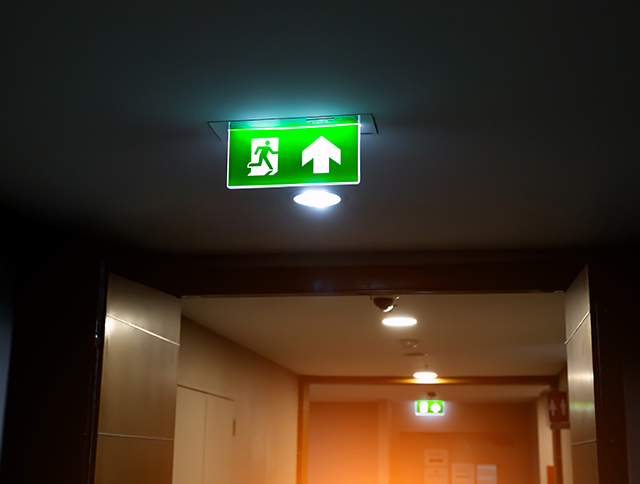
Regular emergency lights are usually of a thermoplastic material and are designed for interiors such as common areas of apartment and condo complexes, office buildings and retail outlets. They are used in places that do not experience extreme weather conditions and aren’t exposed to hazardous materials.
Wet condition emergency lights are impervious to rainfall and other inclement weather – essential in the Lower Mainland. They are usually housed in a rust-resistant fibreglass casing. Some have internal heaters to prevent the batteries from freezing in cold weather. As well as outdoor applications, some interiors such as swimming pools and greenhouses that are susceptible to high humidity may also be suitable for wet condition emergency lights.
Hazardous emergency lights are used in industrial settings that contain flammable air-borne debris and vapors. They are designed so the debris and vapors cannot penetrate the casing. They are usually made out of a very rugged material such as steel to withstand significant damage. Explosion-proof models are also available.
Industrial grade emergency lights and exit signs are often used in public parkades, warehouses, industrial operations and large public venues. They are made from durable materials such as steel in order to withstand significant damage and vandalism. Emergency lights can be either maintained or non-maintained.
Most emergency lights that we install are non-maintained. Non-maintained simply means that they only function in an emergency situation. Maintained emergency lights are illuminated at all times – during normal use they are powered by the main electrical supply and during a power failure, they are battery powered.
Exit signs are ‘maintained’ as they are always illuminated. They are powered by the central power source during normal operations and by battery back up during power failure.
Most emergency lights are incandescent. Energy efficient LEDs are available for a number of fittings as well.
Depending on the building, emergency lights in BC are required by Code to run for 60-120 minutes upon central power failure. Emergency lights in small, simple buildings usually have self-contained batteries in each unit. Batteries are normally 12 volt with a 1-ft candle output.
In larger, more complex buildings inverters are often used to provide central battery power to emergency lights. Some critical institutions such as hospitals may also have back up generators. We supply a full range of batteries and inverters for all types of buildings and electrical loads.
As with all emergency safety equipment, it’s ability to perform depends on whether it’s fully functional. BC Building Code demands testing to ensure that emergency lights will work when needed.
Emergency lighting and exit signs show you how to evacuate a building safely.
AFS provides full service testing and maintenance of all emergency lights and exit signs. As per NFPA and local authorizing jurisdictions, most buildings are required to perform a once-monthly 30-second test of all emergency lights. This test can be done internally. An annual function test, however, must be performed and documented by a certified company. An annual function test includes:
For exit signs, a once-monthly visual inspection is warranted as well as an annual inspection. During an annual inspection, exit signs are switched to battery power for a full 90 minutes. Batteries and fixtures are checked to ensure they are not damaged.
At Active Fire & Safety Services, we provide emergency light, exit signs and inverters from a wide variety of trusted manufacturers. We’ll advise you on the best line of cost-effective products that will meet the needs of your operation.
Get the best price when you choose AFS! As one of the Lower Mainland’s top fire protection and prevention companies, we provide and install a full range of life safety system devices including emergency lights, exit signs, inverters and batteries. We also provide complete testing and maintenance services to ensure your system is stable, reliable and code-compliant. Contact us today for your emergency lighting system and exit sign needs today! Use the form to the left or call 604-590-0149.
FAQ
Emergency lighting and exit signs are critical life-safety systems required by the BC Building Code and BC Fire Code. Their primary purpose is to provide an illuminated pathway (egress route) so that building occupants can safely evacuate during a power outage or fire. They also help first responders navigate your building in low-visibility conditions.
Non-Maintained (Standard): These lights remain off during normal operation and only turn on when the building’s power fails. This is the most common type for standard emergency lighting units (the “bug eye” lights).
Maintained: These lights are illuminated 24/7. They run on normal power day-to-day but have a battery backup to keep them lit during a power outage. Exit signs are always “maintained” because they must be visible at all times.
Not necessarily. While the BC Building Code now requires the green ISO Running Man pictogram for new constructions and major renovations, existing red EXIT signs are generally grandfathered in. You typically only need to upgrade them if you are doing a significant renovation, changing the building’s occupancy type, or if the old signs are damaged and need replacement. However, it is best practice not to mix red and green signs in the same visual area.
According to Section 6.5 of the BC Fire Code, you must perform two types of tests:
The required duration depends on your building’s classification under the BC Building Code:
Active Fire technicians will determine the specific requirement for your facility during our inspection.
Yes, a designated staff member can perform the monthly push-button test and visual inspection, provided they keep a written log of the results. However, the Annual Full-Load Test must be performed by a certified fire protection technician (like those at Active Fire) because it involves specialized testing of the battery charging voltage, load current, and recovery period.
The typical lifespan for sealed lead-acid or Ni-Cad batteries used in these units is 3 to 5 years. Factors like temperature fluctuations (e.g., in cold parkades) can shorten this lifespan. If a unit fails the annual duration test (e.g., the light dims or dies after 15 minutes), the battery must be replaced immediately.
A buzzing noise usually indicates a failing transformer or charge circuit board inside the unit. This is a sign that the unit may not be charging the battery correctly and could fail when you need it. You should contact Active Fire to have the unit repaired or replaced.
Yes. We install and service specialized emergency lighting for all environments, including:
Our comprehensive service includes:
It depends on the age and condition of the unit. Often, simply replacing the battery or bulb is cost-effective. However, if the internal circuit board is damaged or the plastic housing is cracked/yellowed (brittle), replacing the entire unit is often safer and more economical. Active Fire stocks a wide variety of parts and replacement units to get you back in compliance quickly.
You can request a quote or book an inspection by calling us at 604-590-0149 or by filling out the Contact Us form on our website.
Active Fire has been serving the Lower Mainland and Fraser Valley for over 25 years. We service Vancouver, Surrey, Burnaby, Delta, Richmond, Coquitlam, Port Coquitlam, New Westminster, Langley, Abbotsford, Chilliwack, Pitt Meadows, Port Moody, Maple Ridge, North Vancouver, West Vancouver, and surrounding areas.
